Seasonality360 Backtest: Validate trading strategies on historical data
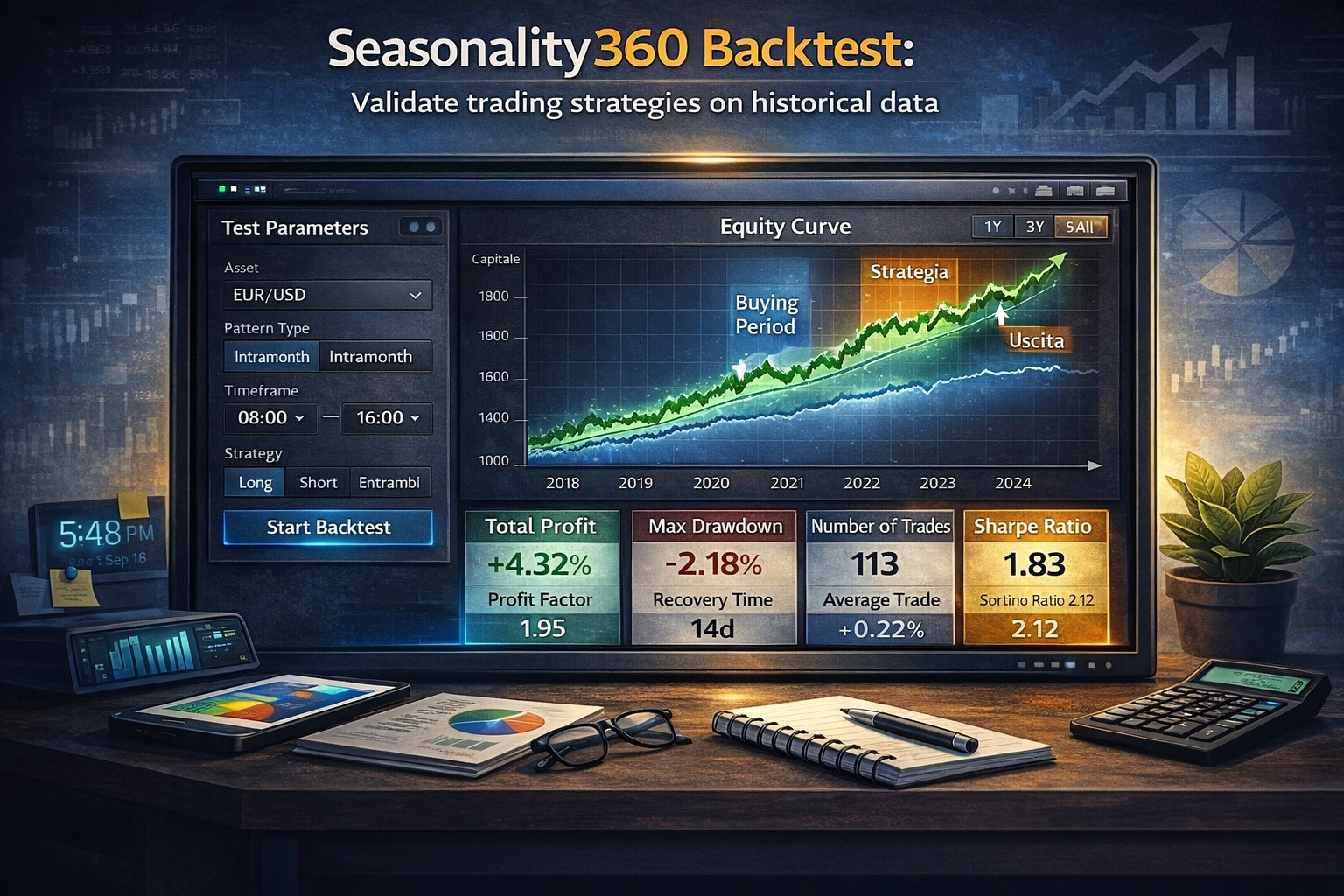
A trading idea is only a hypothesis until you test it. Seasonality360 Backtest helps you validate seasonal setups on historical data quickly, with a no-code workflow designed for real decision-making.
What is Seasonality360 Backtest?
Seasonality360 Backtest is the feature that lets you test a rule-based seasonal idea before risking capital. You can evaluate how a setup behaved historically, inspect its consistency, and judge whether risk fits your plan.
The goal is not to predict the future with certainty. The goal is to replace guessing with structured evidence.
Backtest is especially useful when paired with Screener. Screener finds candidates; Backtest validates them.
Why you need it
Most strategy mistakes happen before execution. Traders often enter because a setup "looks good" instead of proving it with data.
Backtest addresses that directly:
- Faster validation: check ideas in minutes instead of manual spreadsheet work.
- Objective decisions: compare setups with the same criteria every time.
- Better risk awareness: evaluate downside behavior before committing capital.
- No-code workflow: useful for beginners and experienced discretionary traders alike.
If you want to trade with fewer assumptions, Backtest is the checkpoint that keeps your process honest.
How Backtest works in Seasonality360
A practical workflow looks like this:
-
Select setup source
Start from a candidate discovered in Screener or from a known seasonal idea. -
Define test parameters
Set the market, time window, and rule assumptions you want to evaluate. -
Run and inspect results
Review historical behavior, consistency, and downside profile. -
Compare alternatives
Test a second and third variant to avoid over-committing to the first attractive result. -
Decide or reject
Keep setups that meet your risk standards. Reject those that do not. -
Monitor personal research memos
For approved setups, use Radar and Memo Notes to track upcoming windows and keep your research notes actionable.
This keeps your workflow compact: discovery, validation, monitoring, execution.
How to read results responsibly
Backtest output should be interpreted as decision support, not certainty. Three practical checks improve quality:
- compare behavior across different sub-periods instead of one aggregate result;
- avoid over-tuning parameters just to improve past performance;
- prioritize setups whose risk profile you can execute consistently.
If a result looks impressive but depends on very narrow assumptions, treat it as fragile.
Backtest vs trading without Backtest
Without Backtest, most decisions rely on narrative confidence. That creates fragile strategies because:
- one recent example is mistaken for a durable pattern;
- downside risk is underestimated;
- entry/exit rules are adjusted emotionally.
With Backtest, your process becomes explicit:
- you know which conditions were tested;
- you know which risk profile you accepted;
- you can revisit and improve the model over time.
In short, Backtest does not make trading risk-free. It makes your process auditable.
Real use case
Assume you find a seasonal setup in Screener that appears strong in a specific calendar window.
- You send the setup to Backtest.
- You test it across a broader historical sample.
- You compare a stricter and a looser parameter version.
- You reject the variant with unstable downside behavior.
- You keep one version with clearer risk limits and acceptable consistency.
Now your decision is based on evidence, not enthusiasm. That single change improves long-term discipline more than any "new indicator."
Start using Backtest
If you want to improve strategy quality quickly:
- Run your first Backtest
- Discover ideas with Screener
- Learn how to scan patterns automatically
- Review data principles in Methodology
Use Backtest as a standard gate before execution. A strategy that cannot pass historical validation usually does not deserve live capital.
Portfolio Backtest Management
If you already validate single setups and want to move to real portfolio thinking, use Portfolio Backtest Management.
This module lets you:
- compose a portfolio of strategies coming from Screener and Backtest;
- set global rules such as initial capital, allocation logic, and position constraints;
- run one aggregated portfolio backtest instead of isolated strategy tests;
- review both portfolio-level metrics and contribution by strategy;
- save versions (v1, v2, v3) and compare equity/risk side by side.
In short, regular Backtest answers "does this setup make sense?".
Portfolio Backtest Management answers "does this combination of setups behave like a robust account?".
Quick FAQ
Does Seasonality360 tell me what to buy or sell?
No. Seasonality360 never tells you "buy X now" or "sell Y now".
Seasonality360 is a study and research tool.
The decision to open, adjust or close trades in the market is always and only yours.
Risk note: Backtests are based on historical data and assumptions. Results are not guarantees, and all trading activity involves risk.
Ready to test this seasonal idea with real data?
Use Seasonality360 Screener and Backtest on 20+ years of history to turn seasonal patterns into a repeatable playbook.