Easy Trading Strategy: what it really means (and how to find a simple edge with data)
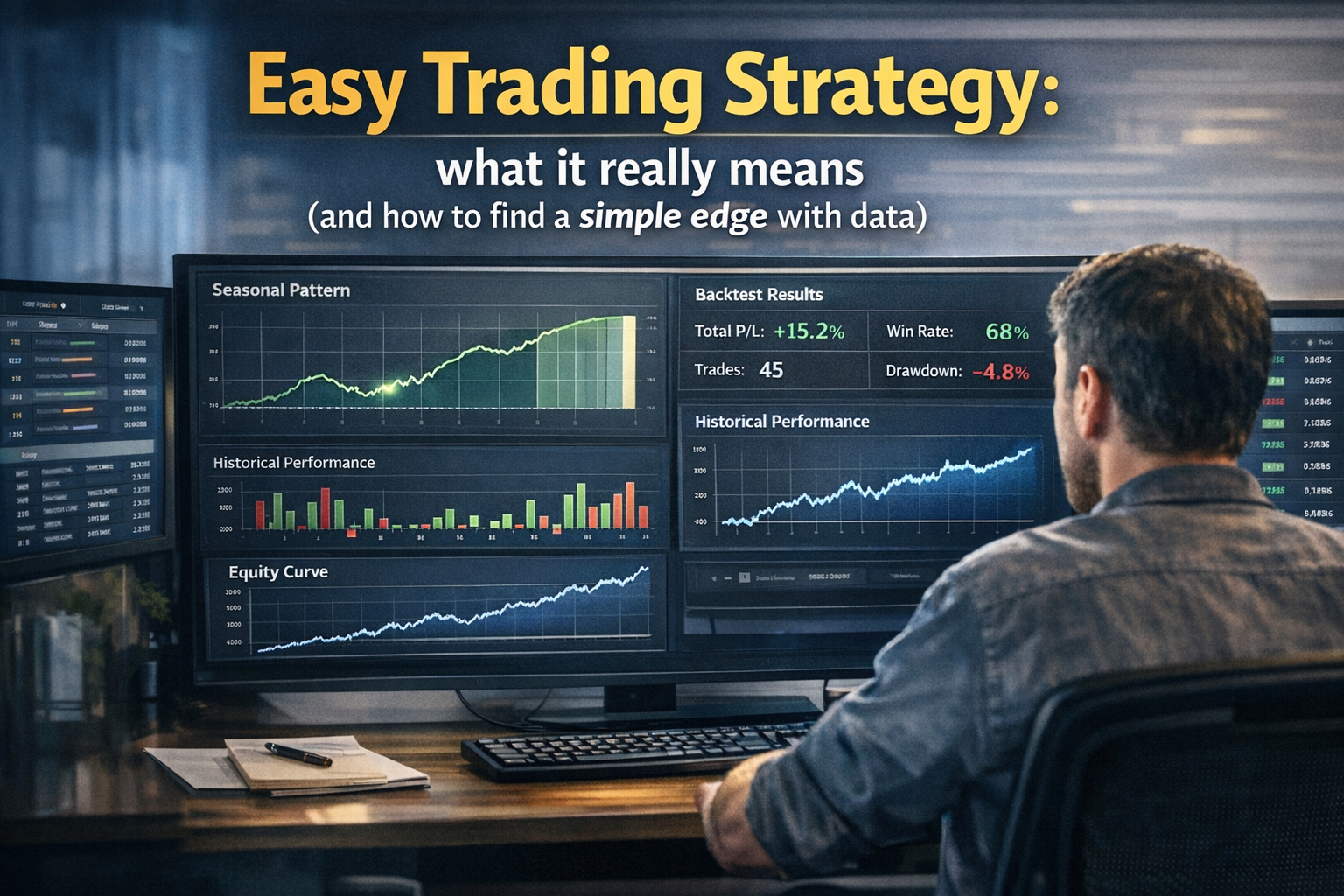
An easy trading strategy is not a shortcut to guaranteed profits. It is a simple, repeatable decision process built on clear rules, historical evidence, and risk control. In other words: fewer moving parts, better discipline. With Seasonality360 Screener and Backtest, you can build that process in minutes without coding.
Why an easy trading strategy matters
Most beginners search for "easy" because they want clarity, not complexity. That is a valid goal. The real issue is that many "easy strategy" articles confuse simplicity with certainty, and that creates bad habits early.
In practice, simple strategies fail when they are based on:
- vague entry and exit rules;
- cherry-picked charts instead of broad historical testing;
- no drawdown constraints;
- emotional overrides after a few losing trades.
A better definition is this: an easy strategy is one you can explain in one minute, test in one hour, and execute consistently for months. That is where seasonality becomes useful. Seasonal behavior is not magic, but recurring calendar windows can provide structured hypotheses you can validate with data.
A simple but effective method
You can use a four-step framework that stays simple while keeping analytical rigor.
1) Start with a specific hypothesis
Avoid broad statements like "this market is bullish." Ask a testable question instead: "Does this asset tend to perform better in a specific calendar window?" Precision at this stage prevents random pattern hunting later.
2) Use Screener to shortlist opportunities
Inside Seasonality360 Screener, filter by market, period, and robustness signals. You are not trying to find the "perfect" pattern. You are trying to reduce noise and focus on setups with repeatable historical behavior.
A practical shortlist usually includes patterns that:
- appear across multiple years;
- do not rely on one extreme outlier year;
- fit your risk tolerance and time horizon.
3) Validate with Backtest before execution
Move each candidate to Backtest and check what really matters: consistency, downside profile, and behavior in different market regimes. This step turns a promising idea into an informed decision.
4) Monitor upcoming windows with Radar and Memo Notes
After validation, use Radar and Memo Notes so you can act on timing without watching charts all day. A strategy stays easy only if execution is operationally simple too.
For transparency on data and methodology standards, also review Methodology.
5) Define a failure rule before you trade
Most traders define entry rules but not invalidation rules. That is a major gap. Before going live, decide what would make you stop or reduce exposure:
- a risk threshold you are not willing to exceed;
- a change in behavior versus historical expectation;
- a maximum number of failed windows before re-evaluation.
This keeps your strategy easy in stressful conditions. If a process is only easy when results are good, it is not truly simple.
Practical example: Screener & Backtest workflow
Assume you are a part-time trader looking for one seasonal setup you can follow with limited screen time.
- Open Screener and choose the market universe you actually trade.
- Filter seasonal windows that show recurring strength or weakness.
- Remove candidates with unstable historical behavior.
- Send the best candidates to Backtest and compare risk-adjusted behavior.
- Keep one setup with clear rules: entry date range, exit logic, and risk limits.
The key output is not a prediction. The output is a repeatable playbook. You know why you are entering, what invalidates the idea, and how much downside you can tolerate.
This is also why data-driven simplicity beats social-media simplicity. Content online often optimizes for attention. Your process should optimize for decision quality.
One practical habit is to keep a one-page strategy sheet. Write the exact setup logic, acceptable risk, and review cadence. If you cannot explain the setup in plain language, it is probably not easy enough yet.
Try it yourself
If you want a realistic easy strategy framework, run this checklist today:
- find 3 candidate seasonal setups in Screener;
- validate all 3 in Backtest;
- keep only the setup with risk profile you can actually trade;
- set Radar/Memo Notes so execution does not depend on memory;
- review assumptions monthly instead of improvising daily.
Useful next steps:
An easy strategy should remove confusion, not remove risk. Keep the process simple, but keep standards high.
FAQ about easy trading strategies
Can an easy trading strategy work long term?
Yes, if it is grounded in data and risk controls. Simplicity supports consistency, but only testing and disciplined execution support durability.
Do I need coding skills to test seasonal ideas?
No. A no-code workflow with Screener and Backtest is enough for most retail validation tasks.
How much historical data is enough?
More context is usually better. Focus on multi-year behavior across different market conditions, not just one favorable period.
Disclaimer: this content is for educational purposes only. Trading involves risk, and past performance does not guarantee future results.
Ready to test this seasonal idea with real data?
Use Seasonality360 Screener and Backtest on 20+ years of history to turn seasonal patterns into a repeatable playbook.