High win rate and low risk trading strategies
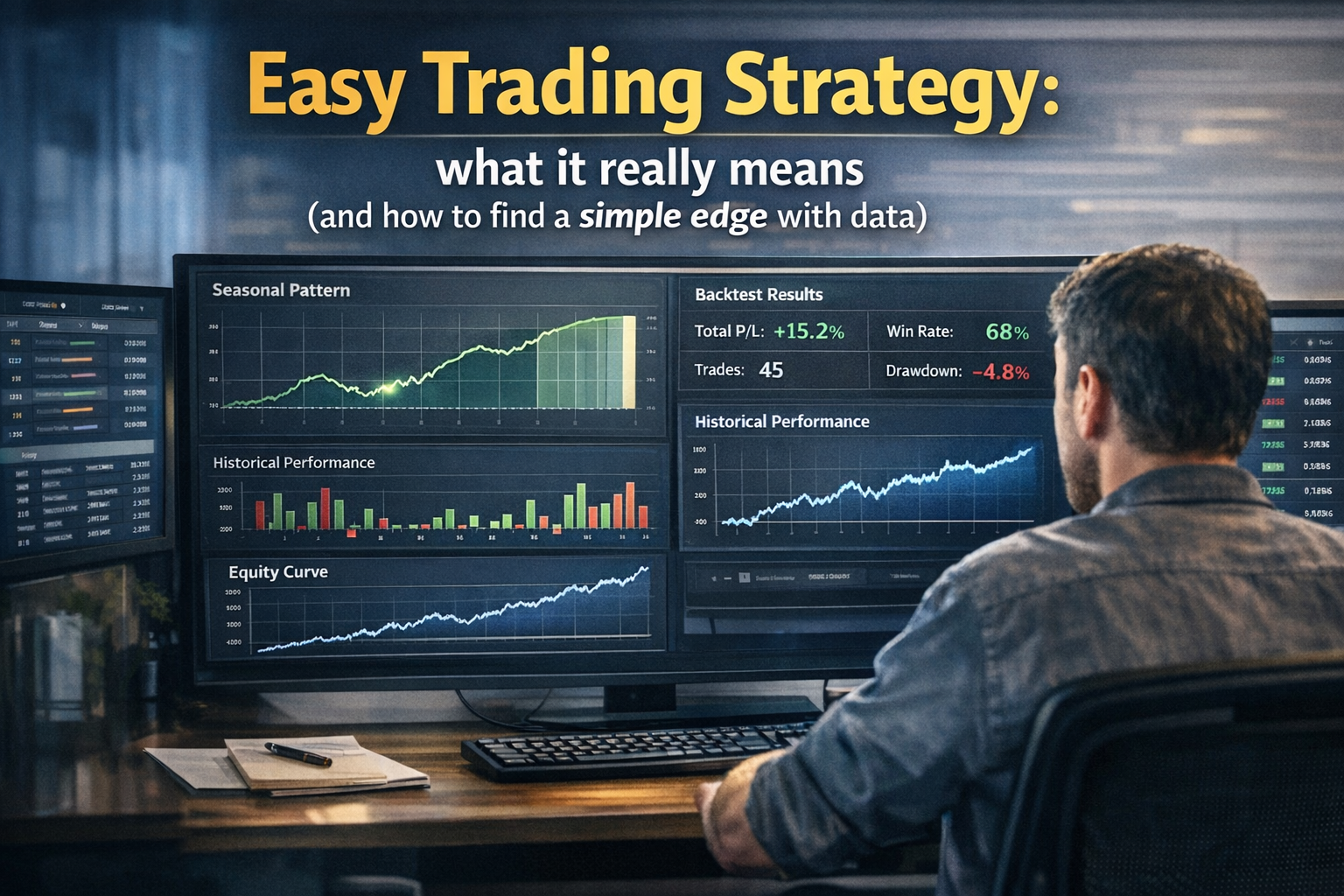
High win rate trading strategies with controlled risk
"High win rate trading strategy" is one of the most searched topics in trading.
The problem: win rate alone doesn't tell you if a strategy is survivable.
With Seasonality360 you can:
- design and test high probability trading strategy ideas,
- compare win rate against drawdown, profit factor and expectancy,
- focus on robust trading strategy behaviour instead of curve-fitted perfection.
You still care about winning often - but with risk under control.
Start analyzing for free - no card required
Build and test high win rate strategies on real data before you trade them.
Why "high win rate" can be a dangerous obsession
Many strategies that claim:
- 80-90% win rate,
- tiny average loss,
- almost no losing days,
hide a different reality:
- rare losses are very large,
- risk builds up silently,
- one event can wipe out months of gains.
A high win rate trading strategy is not automatically a good strategy.
Without looking at drawdown and trade expectancy, you're flying blind.
What really matters beyond win rate
A serious strategy balances:
- win rate - percentage of winning trades,
- average win vs average loss - the payoff profile,
- drawdown - how much equity falls in bad periods,
- expectancy - average outcome per trade,
- robustness - behaviour across multiple years and regimes.
Seasonality360 helps you see these metrics in backtests, so you can choose:
- not just the best trading strategy in theory,
- but the one you can actually stick to in practice.
Seasonality360: build and test high probability trading strategies
Seasonality360 is built for data driven trading strategy design:
-
Strategy backtesting across years
Test intraday trading strategy, swing and seasonal ideas on long histories. -
Risk metrics at a glance
See drawdown, profit factor and trade expectancy for each strategy. -
Compare styles
Evaluate:- best day trading strategy candidates,
- best swing trading strategy setups,
- best scalping strategy ideas,
through the same risk lens.
It's about building strategies you can actually survive and execute.
How it works
1. Define your idea of "high win rate"
For your context, high win rate might mean:
- 65-75% for a day trading strategy with high win rate,
- 55-65% for swing or positional strategies,
- lower win rate but bigger winners for trend-followers.
You define:
- markets you trade,
- timeframes (intraday vs swing),
- basic rules and filters.
2. Build simple, testable rules
Start from a simple trading strategy:
- 2-3 core conditions,
- clear entry and exit rules,
- realistic stops and targets.
You can create:
- a high win rate scalping strategy around certain sessions,
- a simple swing trading strategy around seasonal windows,
- or hybrids aligned with your style.
Avoid complexity until the simple version shows a real edge.
3. Backtest and inspect risk metrics
Run backtests in Seasonality360 to see:
- win rate vs average win/loss,
- max drawdown and recovery periods,
- profit factor strategy metrics,
- overall trade expectancy.
From here you can:
- discard fragile ideas,
- refine promising ones,
- search for low risk trading strategy candidates.
4. Optimise for low drawdown, not just high win rate
Use filters and comparisons to focus on:
- low drawdown trading strategy behaviour,
- stable performance across years,
- acceptable reward-to-risk profile.
This is where:
- high profit factor strategy candidates emerge,
- you move from chasing win rate to building robust trading strategy behaviour.
5. Track live behaviour and adapt
Once you settle on high probability setups:
- save them into your portfolio,
- monitor forward behaviour relative to historical stats,
- adapt only when you have enough data, not after 3 trades.
Seasonality360 is your reference for what "normal" looks like for each strategy.
Use cases for high win rate & low risk setups
Day traders who want frequent wins without blowing up
If you prefer intraday:
- build intraday trading strategy ideas with strict risk limits,
- look for day trading strategy with high win rate but controlled DD,
- use seasonal context to avoid worst days and hours.
The goal is longevity, not dopamine hits.
Swing traders looking for smoother equity curves
If you hold trades for days or weeks:
- design simple swing trading strategy ideas with clear rules,
- combine seasonal context with trend or mean-reversion logic,
- filter for low risk trading strategy behaviour.
You want an equity curve you can handle emotionally.
Prop firm traders under strict risk limits
If you trade prop firm challenges:
- prioritise low drawdown trading strategy candidates,
- monitor risk metrics like Calmar/Sharpe (via the risk pillar if implemented),
- use Seasonality360 together with your prop firm risk management plan.
High win rate is useful only if you stay within the rules.
Systematic traders refining portfolios
If you manage multiple systems:
- treat each strategy as a component,
- use data driven trading strategy comparison across metrics,
- allocate more weight to robust trading strategy segments.
Seasonality360 becomes a lab for portfolio-level decisions.
Why Seasonality360 fits traders obsessed with quality strategies
- Focus on quality of edge, not just flashy equity curves.
- Tools to evaluate high probability trading strategy candidates honestly.
- Easy comparison of multiple strategy styles on the same metrics.
- A framework that encourages robust, realistic expectations.
You can still aim for frequent wins - but with your eyes open on risk.
Continue with related strategy pages
- Test setup mechanics in backtesting software.
- Apply the framework to FX ideas in forex trading strategies.
- Align with strict limits in prop firm risk management.
- Deepen metrics literacy in trading risk: drawdown, Sharpe, Monte Carlo.
FAQ
What win rate should I aim for?
There is no universal number.
For intraday, a high win rate trading strategy might be 60-70%; for trend-following it might be lower but with larger winners. Seasonality360 helps you test and see how different profiles feel in terms of drawdown and expectancy.
Can I build high win rate scalping strategies?
Yes. You can design and test high win rate scalping strategy ideas, using intraday data where available and combining them with broader context. Just make sure to study drawdown and average loss size, not just the percentage of winners.
How do I test if a low risk trading strategy is real?
You run a low risk trading strategy backtest over as many years as possible and inspect:
- depth and length of drawdowns,
- behaviour in stress periods,
- changes in performance across regimes.
Seasonality360 exposes these stats so you can judge for yourself.
Is Seasonality360 only for swing strategies?
No. You can work with intraday trading strategy and swing ideas, as long as you treat them with the same rigour: clear rules, multi-year backtests, and a focus on robustness.
How does Seasonality360 help with robust trading strategies?
By making it easy to:
- test ideas across years and markets,
- compare win rate with drawdown, profit factor and expectancy,
- discard fragile best trading strategy illusions and keep what actually holds up.
Ready to go beyond win rate screenshots?
You can chase promises of 90% win rate - or you can build high win rate trading strategies with transparent risk and multi-year stats.
Start analyzing for free - no card required
Use Seasonality360 to design, test and refine strategies that you can actually trade and stick to.
Ready to test this seasonal idea with real data?
Use Seasonality360 Screener and Backtest on 20+ years of history to turn seasonal patterns into a repeatable playbook.