How to Backtest a Trading Strategy in Minutes (No Coding Required)
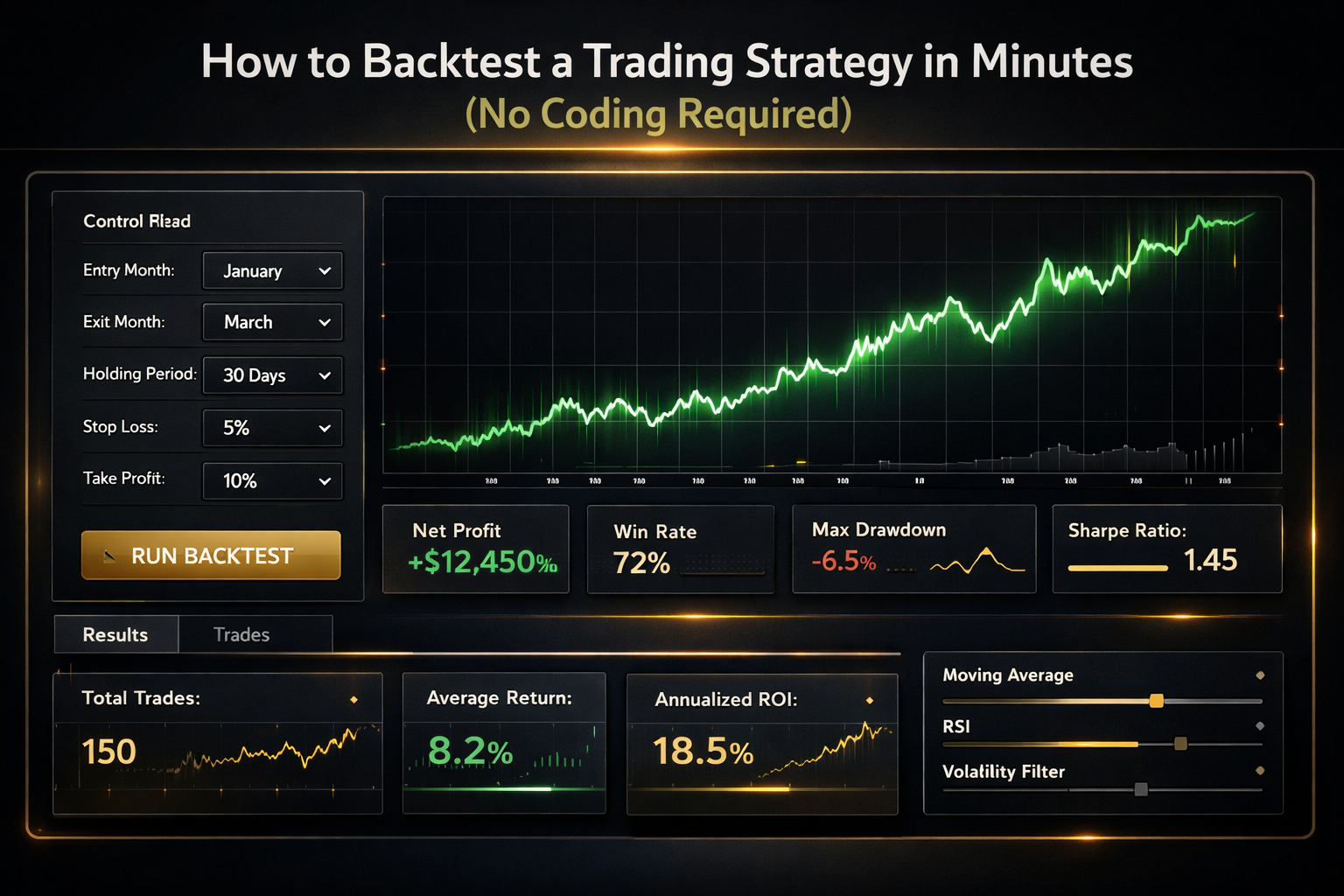
Problem: many traders have ideas but no disciplined way to test them before risking capital.
Quick solution: Seasonality360 Backtest enables fast no-code validation.
Why this tool is essential
Backtesting is the bridge between hypothesis and execution. It helps avoid narrative-driven decisions and improves consistency across setups.
Practical advantages:
- objective comparison between variants;
- visible downside behavior before live trading;
- clearer rejection criteria;
- stronger process discipline.
How to use Seasonality360 Backtest
- Start from a setup idea or Screener candidate.
- Define market, timing window, and rules.
- Run the test and evaluate consistency.
- Compare multiple variants.
- Keep only robust setups.
- Monitor timing using Radar and Memo Notes.
Use Methodology as a reference framework.
Practical use case
You identify a recurring window in Screener. Backtest reveals that one variant has attractive average behavior but unstable downside. A second variant is more balanced, so you keep it and prepare execution Memo Notes.
This is how no-code testing improves real decision quality.
Take action
FAQ
Can I backtest without programming?
Yes.
Are results guaranteed?
No. They are historical evidence.
How many variants should I test?
At least two or three before execution.
Disclaimer: educational content only. Trading involves risk, and past performance does not guarantee future results.
Advanced workflow tips
Once you are comfortable with the basics, improve your workflow with batching. Run research in blocks: discovery block, validation block, and execution-planning block. Batching reduces context switching and improves consistency.
Another useful practice is score-based selection. Assign a simple score to each candidate based on robustness, downside behavior, and execution simplicity. Keep only top-scoring setups and ignore the rest.
Typical mistakes and fixes
Common mistakes include selecting too many candidates, skipping variant comparison, and mixing research criteria with execution criteria. Fix these by setting explicit limits:
- maximum three active candidates at once;
- minimum two variants tested per candidate;
- one clear reason for rejection or approval.
Weekly operating routine
Monday: run discovery and shortlist. Mid-week: validate and rank with risk criteria. Before window: set Memo Notes and execution checklist. After window: record results and update assumptions.
A routine like this turns a useful tool into a dependable process.
Process quality controls
To get durable value from this tool, add quality controls: fixed candidate limit, mandatory variant comparison, and one explicit reason for every approval/rejection decision. These controls prevent tool overuse and keep focus on decision quality rather than feature exploration.
A simple rule works well: if a setup cannot be explained in one paragraph with clear risk assumptions, it is not ready for execution.
Adoption plan for better outcomes
A good adoption plan is simple: use the tool weekly, not occasionally. Create one fixed research session, one fixed validation session, and one fixed review session. Over a few weeks, this cadence improves both speed and judgment quality.
Also keep a shortlist limit. Too many active candidates reduce focus and execution quality. High-quality selection with fewer setups usually beats broad but shallow exploration.
From feature usage to execution edge
The key upgrade is consistency. Use the same research criteria every week, the same validation criteria every time, and the same rejection rules when quality drops. Over time, this consistency compounds and produces better decisions than occasional deep dives.
Final process note
Consistency is the real edge. Keep one workflow, one risk language, and one review cadence. The goal is not to predict perfectly; it is to make better repeatable decisions under uncertainty.
Ready to test this seasonal idea with real data?
Use Seasonality360 Screener and Backtest on 20+ years of history to turn seasonal patterns into a repeatable playbook.