The Weekend Effect (Monday Effect): Does the market really drop on Mondays?
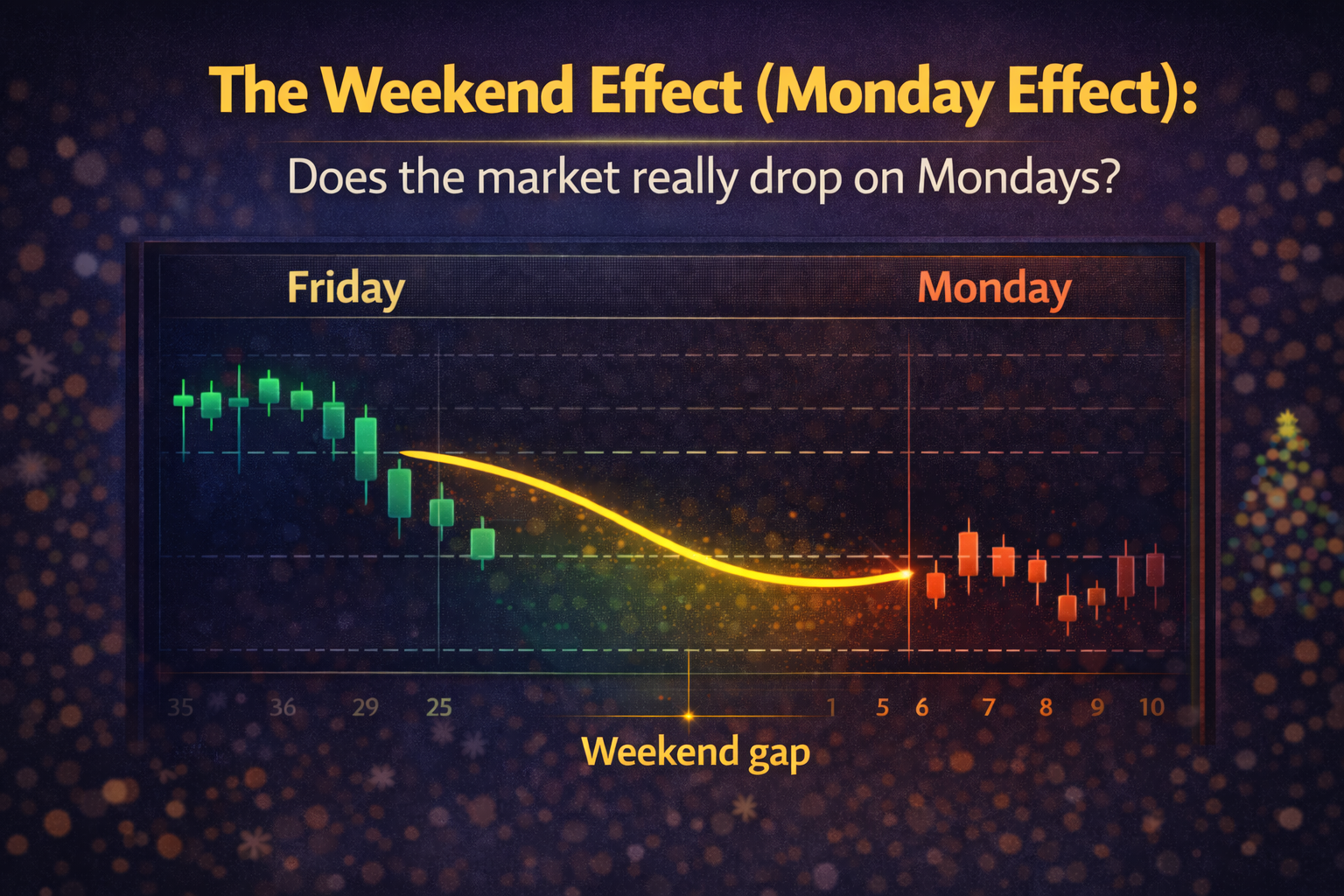
The Weekend Effect (Monday Effect): Does the market really drop on Mondays? is a popular seasonal topic because traders want to know if it is a real edge or just market folklore. The useful approach is not blind belief, but structured validation. You can test this pattern with Screener and Backtest, then monitor timing through Radar and Memo Notes.
Origin and logic of the pattern
Most seasonal patterns are linked to recurring flows, calendar constraints, institutional behavior, and participant psychology. These drivers can create repeated tendencies, but they do not guarantee the same outcome every year.
The practical interpretation is simple: use the pattern as a timing hypothesis. If it appears robust across long samples, it can support decision quality. If robustness weakens, it should be reduced or rejected.
Historical data: myth or reality?
The right question is not "does it work once?" but "does it remain stable across years and regimes?" A robust evaluation checks frequency, distribution, downside behavior, and implementation assumptions.
Use this process:
- find candidate assets in Screener;
- test the exact time window in Backtest;
- compare multiple variants to avoid overfitting;
- track the next live windows with Radar and Memo Notes;
- align assumptions with Methodology.
How to use it responsibly
Treat the pattern as context, not certainty. Define entry logic, invalidation criteria, and position-size limits before going live. Avoid all-or-nothing behavior: a pattern can still be useful even if it fails in some years.
Good implementation means process discipline:
- predefined risk limits;
- no discretionary rule changes mid-trade;
- periodic re-validation;
- realistic expectations on variability.
Try it yourself: verify this pattern
Open Screener and build a shortlist where this effect appears recurrently. Run Backtest on every candidate and keep only setups with stable risk-adjusted behavior. Then use Radar and Memo Notes for upcoming windows.
Related reads:
FAQ
Does this pattern work every year?
No. Seasonal effects are probabilistic and can vary by market and period.
Can beginners use this pattern?
Yes, if they use a data-first workflow and strict risk rules.
What is the minimum validation process?
Screen, backtest, compare variants, then monitor timing before execution.
Disclaimer: educational content only. Trading involves risk, and past performance does not guarantee future results.
Additional validation checklist
To improve confidence, run a second validation layer before execution. Compare this pattern across multiple instruments, then compare multiple date-window definitions. If the edge only appears under one narrow configuration, confidence should stay low.
A robust candidate usually shows:
- recurring behavior across many years;
- acceptable downside in unfavorable periods;
- stable results after small parameter changes.
Risk and execution discipline
Even when the pattern looks strong, execution quality remains critical. Define position size before entry, set invalidation rules, and avoid adjusting logic mid-trade because of short-term noise.
You can also use a pre-trade checklist:
- Is this setup validated in Backtest?
- Does downside fit my risk budget?
- Is current context compatible with historical behavior?
- Is my execution plan written and clear?
Post-window review
After the window closes, review outcome versus expectation. Did the pattern behave within historical variability? Did you follow your own rules? This review loop is where long-term edge quality is built.
Scenario planning for this pattern
Before trading this pattern, write three scenarios: expected behavior, weaker-than-expected behavior, and invalidation behavior. For each scenario, define position-size response and risk limits. This helps prevent emotional adjustments after entry.
After each window closes, run a quick review: did behavior stay within expected variability, did execution follow the plan, and does the setup remain valid for future windows? This review loop is essential for long-term robustness.
Ready to test this seasonal idea with real data?
Use Seasonality360 Screener and Backtest on 20+ years of history to turn seasonal patterns into a repeatable playbook.